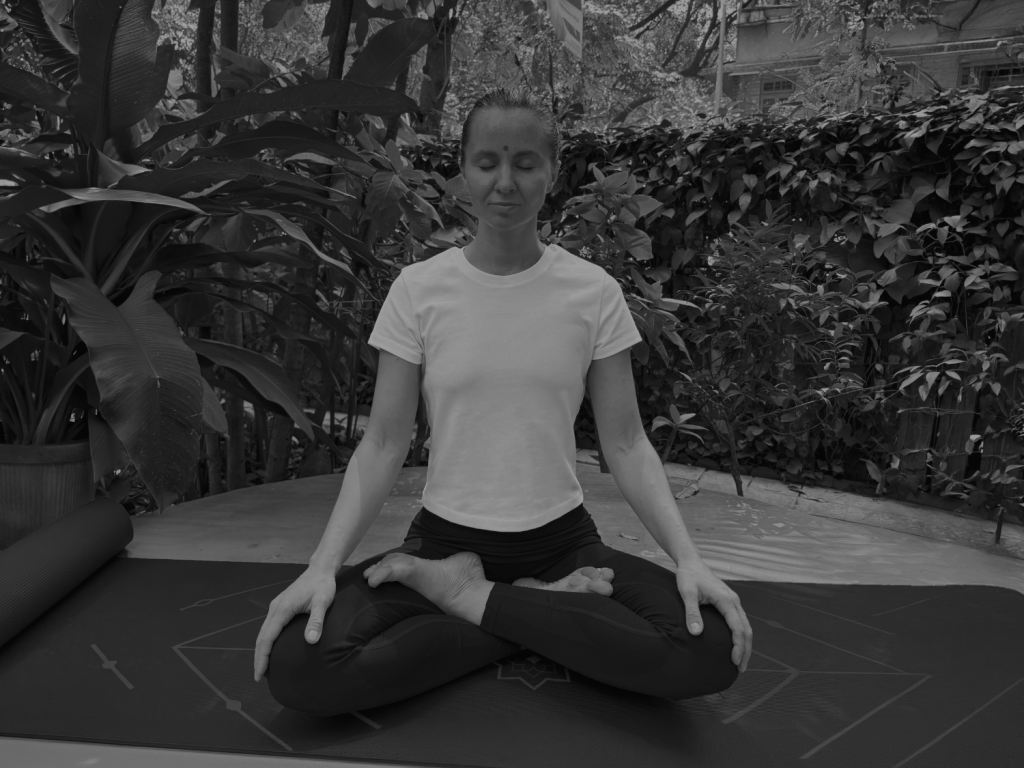
Modern psychology and classical yoga answer the same question differently.
Meditation is often promoted as a way to reduce stress, improve focus, sleep better, or regulate the nervous system. Classical yoga presents a much broader vision. Rather than seeing meditation primarily as a relaxation technique, traditional texts describe it as a path toward Self-knowledge and liberation. Both perspectives offer valuable insights-but they are not aiming at exactly the same goal.
Why We Keep Asking This Question?
Walk into a wellness studio, open a meditation app, or skim advice about burnout, and meditation is usually presented as a way to feel calmer, sleep better, improve concentration, and reduce stress.
That framing did not appear out of nowhere.
In the United States, the proportion of adults who reported practicing meditation more than doubled between 2002 and 2022. Most people who practice mindfulness meditation say they do so to relax, manage stress, or improve sleep. Modern research also suggests that mindfulness-based approaches can help reduce anxiety, depression, and psychological distress on average.
But if you ask the classical yoga texts what meditation is actually for, the answer is both broader and far more demanding. In those traditions, meditation is not primarily a wellness habit, a productivity tool, or a technique for calming the nervous system. It is one stage of a disciplined path whose ultimate aim is freedom from suffering, ignorance, and mistaken identification with the restless mind.
From this perspective, calming the nervous system certainly matters-but it is not the destination. It is preparation. It is purification.
Sometimes it is simply a byproduct of something much deeper: discovering what remains when we are no longer completely identified with thoughts, desires, fears, and the stories we tell ourselves about who we are. So the most accurate answer to the title of this article is not simply “spiritual” or “nervous system training.”
Meditation can be both. Yet classical yoga places these two ideas in a clear hierarchy. Nervous system regulation supports practice, while spiritual freedom is its ultimate aim. Modern psychology captures an important part of meditation. It simply does not capture the whole picture.
What Meditation Meant in Classical Yoga?
The oldest yoga texts do not describe meditation as “clearing your mind” or simply “being present” in the modern wellness sense. Instead, they present meditation as a disciplined process of transforming consciousness itself. The Katha Upanishad links yoga to the stilling of the senses together with the steadying of the mind and intellect. Importantly, it distinguishes this state from dullness or passivity. Inner stillness is not meant to produce sedation but clarity, ethical composure, and Self-knowledge. The Maitri Upanishad develops this vision further. It describes a sixfold yoga consisting of breath regulation, withdrawal of the senses, meditation, concentration, contemplation, and absorption. According to the text, this gradual discipline leads to knowledge of the Self and union with the highest reality. One of its most psychologically striking statements is: “Mind alone is saṃsāra.” In other words, bondage is not created only by external circumstances. It is continuously recreated through the conditioned habits of the mind itself. Meditation, therefore, is not an escape from life. It is a retraining of the very process through which experience becomes suffering. The Bhagavad Gītā approaches meditation from another angle. It does not describe the ideal practitioner as someone who withdraws from the world altogether. Instead, Krishna teaches that the true yogi performs necessary action without becoming attached to its results. Chapter 6 also emphasizes solitude, steady posture, fearlessness, disciplined attention, and moderation in food, sleep, work, and recreation. This balance is significant. The Gītā’s practitioner is neither an escapist nor someone simply trying to regulate the nervous system. Rather, meditation becomes part of learning how to participate fully in life without becoming psychologically owned by it.
Meditation Was Never Just About Relaxation. Perhaps the clearest explanation comes from Patañjali’s Yoga Sūtra. The text famously defines yoga as: “The stilling of the fluctuations of the mind (citta).”
Meditation itself is only the seventh limb of the eightfold path. Before it come:
- ethical living (yama)
- personal discipline (niyama)
- posture (āsana)
- breath regulation (prāṇāyāma)
- withdrawal of the senses (pratyāhāra)
- concentration (dhāraṇā)
Only after these foundations does sustained meditation (dhyāna) naturally develop, eventually leading toward samādhi, the state in which awareness becomes completely absorbed in its object.
This sequence matters. Classical yoga never treats meditation as an isolated technique. Instead, it presents it as the natural outcome of a way of living. Another common misunderstanding also deserves clarification. Modern yoga culture often places enormous emphasis on posture. Historically, however, āsana was never the centre of yoga practice. The Yoga Sūtra devotes remarkably little attention to physical poses. Classical commentators consistently describe posture as serving one essential purpose: creating a stable and comfortable seat for meditation. Compared with ethics, mental discipline, and contemplative practice, physical postures occupy only a small part of the overall system. Understanding this historical context changes how meditation is viewed. Rather than being an optional addition to physical yoga, meditation was always the heart of the practice. Posture existed to support it-not the other way around.
The Real Goal: Freedom From Misidentification.
If meditation is not primarily about stress reduction, then what problem is it trying to solve? Classical yoga answers this question through its diagnosis of suffering itself. According to Patañjali, the mind is filled with patterns, impressions, habits, and constant fluctuations that keep consciousness entangled with the changing world.
Beneath these movements lie the kleśas-the fundamental causes of suffering:
- ignorance (avidyā)
- egoic misidentification (asmitā)
- attachment (rāga)
- aversion (dveṣa)
- clinging to life (abhiniveśa)
Among these, ignorance occupies a central place. It is described as mistaking the temporary for the permanent, the non-self for the Self, and what ultimately produces suffering for what truly brings fulfillment. Meditation therefore becomes much more than concentration training. It is part of a profound re-education of identity. The deeper problem is not simply an overactive nervous system. The deeper problem is that we gradually become fused with our thoughts, memories, fears, ambitions, emotions, and social roles-then mistake that entire bundle for who we really are. Meditation gently loosens that identification. Instead of trying to eliminate thoughts, it changes our relationship with them. Thoughts continue to arise. Emotions continue to arise. But they are no longer granted unquestioned authority over experience. Classical yoga would say that calm may support this process. It would not say that calm itself is liberation.
Ethics Are Part of the Practice Understanding meditation in classical yoga also explains why ethics appear before meditation in the Eight Limbs. Many modern practitioners see the yamas and niyamas as optional philosophy-valuable perhaps, but separate from meditation itself. Patañjali presents the opposite view. He begins with nonviolence, truthfulness, non-stealing, moderation, and non-grasping because the way we live shapes the quality of the mind we bring to practice. A life driven by aggression, dishonesty, envy, or constant acquisition naturally produces a restless and unstable mind. Meditation, then, is not morally neutral attention training. It grows out of daily habits. How we live influences how we meditate, and meditation gradually influences how we live. The relationship works in both directions. Someone cannot spend an entire day feeding comparison, resentment, compulsive desire, and distraction, then expect twenty minutes of breath awareness to produce lasting wisdom. Classical yoga suggests that meditation is supported by an ethical life because ethics gradually reduce the inner conflicts that keep the mind agitated.
Is Meditation Always Religious?
Another misconception deserves clarification. People often assume meditation must be either religious or completely secular. The classical texts are more nuanced. Patañjali certainly includes devotion to Īśvara and presents the recitation of Om as one path toward one-pointed attention. But he also describes several other approaches. Devotion is important. It is simply not the only doorway into meditation. The Bhagavad Gītā takes a more openly devotional approach. Yet even there, meditation is presented less as adherence to a religion than as a disciplined path toward truth, liberation, and Self-knowledge. This distinction matters. The spiritual dimension of classical yoga is broader than modern categories like religious versus secular. Meditation can include posture, breath, concentration, ethical living, and even devotion while remaining oriented toward a single question: What remains when mistaken identification falls away?
What Modern Psychology Can Explain
Modern psychology has contributed enormously to our understanding of meditation. Rather than asking metaphysical questions about liberation, it investigates measurable changes in attention, emotion, and behaviour.
Researchers often describe meditation as a family of practices that train:
- attention
- emotional regulation
- self-awareness
- interoceptive awareness (our perception of internal bodily sensations)
Put simply, meditation appears to help many people notice what is happening in mind and body earlier, respond less automatically, and relate to difficult experiences with greater stability. That is not a trivial achievement. It represents a genuine form of psychological training.
What the Research Actually Shows
Meditation research has grown rapidly over the past two decades. The overall picture is encouraging-but more cautious than popular headlines often suggest. Reviews from the U.S. National Center for Complementary and Integrative Health (NCCIH) conclude that mindfulness-based approaches are generally more effective than receiving no treatment for anxiety, depression, and stress. Some analyses even suggest they perform similarly to established psychological treatments for certain conditions. However, more recent large-scale analyses also emphasize something important: Average benefits do not mean everyone benefits equally. People respond differently. Some experience substantial improvements. Others notice little change. A small number may even experience negative effects. Meditation is promising. It is not a universal cure. This balanced perspective is worth preserving. Overselling meditation ultimately weakens its credibility. The scientific evidence is encouraging precisely because it avoids making exaggerated claims.
Is Meditation Really Nervous System Training?
One of the most popular ways meditation is explained today is through the language of the nervous system.
Social media is full of statements such as:
- “Meditation regulates your nervous system.”
- “Meditation activates the vagus nerve.”
- “Meditation increases HRV.”
There is some truth here. Meditation can influence stress physiology, autonomic regulation, and heart-rate variability. But reducing meditation to “nervous system training” oversimplifies both the science and the tradition. The strongest research reviews are considerably more cautious than popular wellness content. A 2021 meta-analysis examining randomized controlled trials concluded that there was insufficient evidence to say mindfulness interventions reliably improve resting vagally mediated heart-rate variability compared with control groups. Results varied substantially across studies. That does not mean meditation has no physiological effects. It means the evidence does not support reducing an extraordinarily rich practice to one biological mechanism. The nervous system is part of the story. It is not the whole story.
Meditation Is Not Always Relaxing
Another widespread misconception is that meditation should always feel peaceful. Classical yoga never makes that promise. Neither does modern science. The NCCIH notes that adverse experiences do occur during meditation. A 2020 review estimated that roughly 8% of participants in meditation studies reported unwanted effects, including increased anxiety, emotional distress, or depressive symptoms. Large meta-analyses similarly conclude that some people may not benefit, while others may experience temporary difficulties. This should not surprise us. Classical traditions have long recognized that becoming still can initially expose what constant activity keeps hidden. When external distractions quiet down, unresolved grief, fear, craving, or psychological conflict may become more visible. Meditation sometimes reveals disorder before it begins reorganizing it. That possibility deserves to be discussed honestly. Doing so makes meditation neither less valuable nor less spiritual. It simply makes our understanding more realistic.
Where Ancient Yoga and Modern Psychology Meet
Despite their differences, classical yoga and contemporary psychology converge in fascinating ways. Imagine a familiar situation. You receive a sharp message at work. Your chest tightens. Your jaw clenches. Before you’ve consciously thought about it, you’re already composing a defensive reply. Psychology explains this through emotional reactivity, attentional processes, and automatic regulation. Meditation can help create enough awareness to notice the body’s response before behaviour follows. Classical yoga describes the same moment differently. Old impressions (saṃskāras), attachment, aversion, and ego-defense arise almost instantly, pulling awareness into habitual reaction. The vocabulary changes. The practical insight does not. Both perspectives encourage the same skill: Creating space between experience and automatic identification.
Meditation in the Age of Doomscrolling
Consider another ordinary modern habit. You reach for your phone without thinking. One notification becomes ten minutes of scrolling. Ten minutes becomes thirty. Your attention feels increasingly fragmented, yet stopping becomes surprisingly difficult. A psychologist might describe this through reinforcement learning, attention capture, emotional regulation, and habit formation. Patañjali might explain it through the cycle of kleśa, vṛtti, saṃskāra, and karma.
Different language. Remarkably similar observation. In both cases, the mind becomes conditioned through repeated patterns of attention. Meditation is not simply taking a break from that process. It is training against it. Rather than allowing attention to be endlessly captured by external stimulation, meditation gradually develops the capacity to remain steady in the presence of distraction.
Where Ancient Yoga and Modern Psychology Part Ways
Despite their many overlaps, classical yoga and modern psychology are ultimately trying to answer different questions.
Psychology generally asks:
How can we reduce suffering and help people function more effectively?
Classical yoga asks a more radical question:
Who is the “self” that experiences suffering in the first place?
This difference shapes everything that follows. Psychological research is primarily concerned with improving well-being, emotional regulation, resilience, and mental health. Classical yoga certainly values these outcomes. But it treats them as milestones rather than the destination. Its ultimate concern is liberation (mokṣa): freedom from ignorance, attachment, and mistaken identification with the changing contents of experience. For psychology, meditation often becomes a means of improving life. For classical yoga, meditation becomes a means of seeing through the assumptions that shape our experience of life itself. Neither perspective is necessarily wrong. They simply operate at different levels.
Why Modern Culture Often Misses the Point
The popularity of meditation has undoubtedly helped millions of people. More people are learning to pause, breathe, and observe their minds than ever before. That is something worth celebrating. At the same time, modern culture often asks meditation to solve problems that it helped create. We work longer hours, consume endless streams of information, compare ourselves constantly through social media, and struggle to disconnect from devices designed to compete for our attention. Meditation is then offered as a way to recover from these conditions. Classical yoga would probably ask a different question. Instead of asking how meditation can help us cope with an overstimulating life, it might ask why our lives became so dependent on constant stimulation in the first place. Stress is not viewed only as a physiological state. It is also connected to craving, identification, distraction, and the restless search for satisfaction outside ourselves. From this perspective, meditation is not simply a recovery tool.It becomes an invitation to examine the habits that make recovery necessary.
Can These Perspectives Be Integrated?
Fortunately, choosing between science and classical yoga is unnecessary. The two perspectives can complement one another without becoming identical. Modern psychology offers valuable methods for measuring outcomes, understanding attention, investigating emotional regulation, and improving mental health. Classical yoga contributes something equally valuable: A philosophical framework for asking what kind of life those psychological skills ultimately serve. Together, they provide a fuller picture. Science helps explain how meditation changes behaviour, attention, and the nervous system. Yoga asks why those changes matter. One explores mechanisms. The other explores meaning. When held together, they enrich rather than contradict one another.
What Meditation Looks Like in Everyday Life
Meditation is often imagined as something that happens on a cushion. In reality, its effects become visible long before-or long after-we sit down to practice.
At Work
A difficult email arrives. The immediate impulse is to react. Meditation does not guarantee calm. What it can offer is a brief moment of awareness before habit takes over. That pause may be enough to choose a wiser response.
In Relationships
Someone we care about disappoints us. The mind quickly creates stories. “They don’t respect me.” “They’re pulling away.” Meditation helps us notice these narratives before treating them as unquestionable facts. Awareness creates room for curiosity instead of immediate certainty.
During Stress
Modern life constantly rewards urgency. Meditation does not remove deadlines, responsibilities, or uncertainty. Instead, it gradually changes our relationship with them. Stress may still arise. It simply becomes less likely to define the whole of our experience.
In Daily Life
Perhaps the deepest change is also the quietest. We begin noticing how often attention is pulled by memory, anticipation, comparison, or distraction. Little by little, awareness becomes less reactive. Not because life becomes easier. Because the mind becomes less compelled to chase every thought that appears.
Key Takeaways
- Meditation has been understood very differently across history. Modern psychology often emphasizes stress reduction and emotional regulation, while classical yoga places meditation within a path toward Self-knowledge and liberation.
- In the Yoga Sūtra, meditation is not an isolated technique. It develops naturally from ethical living, disciplined practice, concentration, and the gradual quieting of the mind.
- Scientific research supports many benefits of meditation, particularly for anxiety, stress, and emotional regulation. However, evidence is more nuanced than popular wellness claims often suggest.
- Nervous system regulation is one important effect of meditation, but reducing meditation to vagal tone or stress physiology overlooks much of both the science and the classical tradition.
- Ancient yoga and modern psychology frequently describe similar human experiences using different language. Both recognize the value of observing thoughts rather than reacting automatically to them.
- The deepest difference lies in their aims. Psychology primarily seeks improved functioning and well-being, while classical yoga seeks liberation from mistaken identification with the changing contents of the mind.
Final Thoughts
So, is meditation a spiritual practice or nervous system training? The most honest answer is that it can be both. Meditation can calm the body, strengthen attention, improve emotional regulation, and support psychological well-being. Modern research provides good reason to value these effects. Classical yoga, however, invites us to look beyond them. It suggests that the greatest obstacle is not simply stress, distraction, or emotional discomfort, but our tendency to mistake the movements of the mind for the whole of who we are. From that perspective, a calmer nervous system is not the final destination. It is one condition that makes deeper insight possible. Perhaps the real value of meditation lies in allowing these two perspectives to remain in conversation. Science helps us understand what meditation does. Yoga asks what meditation is ultimately for. Holding both together does not diminish either tradition. Instead, it offers a richer understanding of one of humanity’s oldest and most enduring contemplative practices.


Leave a Reply